


Rosie’s Colic Scare: A Waiting Game
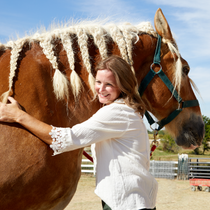
One morning, our paint horse Rosie truly scared us.
She stopped eating, began pawing at the ground, and kept trying to lie down—clear signs she was in pain. It was obvious something wasn’t right.
When Walking Isn’t Enough
We immediately gave Rosie Banamine and started walking her to help manage the colic. Normally, we avoid hauling horses in dangerous weather unless absolutely necessary.
That week brought sudden snow and icy conditions, making roads slick and travel especially risky. Even so, Rosie’s pain made it clear we couldn’t wait.
This was that emergency.
A Concerning First Exam
At her initial hospital exam, the ultrasound raised serious concerns. The doctors suspected the early stages of a strangulated lipoma in her intestines.
On the ultrasound, there were two very distinct, perfect loops of intestine. That’s not normal. Healthy intestines should look more irregular and “mashed together.” Even more alarming, Rosie’s intestinal walls measured 7–8 mm thick, when they should be closer to 3 mm.

A Difficult Reality
The only treatment for a strangulated lipoma is surgery.
Sadly, Rosie is not a surgical candidate due to several factors, including her age, arthritis, swayback, and Cushing’s disease.
The odds were not in her favor. We didn’t want to make her suffer—but we also wanted to give her a chance.
Giving Her That Chance
For Rosie, that meant starting IV fluids and watching her response very closely. In cases like this, we typically know within a few hours whether things are improving or worsening.
Then something hopeful happened.
A Promising Turn
Rosie began responding very well to fluids.
That response made the team question whether the ultrasound findings truly represented a strangulated lesion after all. While there was clearly a loop (or something) causing thickening of the intestinal wall, there are a few other possibilities:
-
Neoplasia: a mass within the intestinal wall (unusual, but not impossible)
-
Inflammation or congestion: where blood flow isn’t draining properly from the intestine
-
Infection: considered unlikely, as Rosie’s white blood cell count was low to normal
Strangulated lesions are the most common cause in cases like this, which is why they were initially suspected. However, horses with true strangulations usually become extremely painful very quickly, with worsening ultrasound findings and belly tap results.
That wasn’t happening.
Two Doctors, One Horse
Dr. Chisholm and Dr. Metcalf had a call together to review all of Rosie’s results. Dr. Chisholm is caring for Rosie at the hospital, while Dr. Metcalf sees her regularly on farm calls and knows her history inside and out.
Having two veterinarians who know Rosie so well collaborate and advocate for her has been nothing short of incredible.
Another Update—Even Better News!
Rosie continued to do remarkably well.
She responded beautifully to fluids and hasn’t needed any additional pain medication. The plan is to take her off fluids, repeat bloodwork and another ultrasound, and closely monitor her response.
If everything continues to look good, we’ll begin making plans to bring her home.
Best Friends, Even at the Hospital
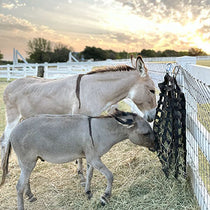
Since the moment they met at the Sanctuary, Rosie and Lucy have been inseparable. They bicker like sisters, then graze side by side—with Harvey trailing along, of course.
By pure timing, Lucy was being discharged from the hospital just as Rosie was admitted. The two best friends were able to share a quiet moment together before heading in opposite directions.
Sometimes, even in the middle of fear and uncertainty, there are moments of comfort.

Holding Hope
Rosie’s story isn’t finished yet—but right now, we are hopeful.
Thank you for holding her in your thoughts, for supporting our Sanctuary, and for standing with us as we navigate the hard moments alongside the hopeful ones. We’ll continue to share updates as Rosie’s journey unfolds.


